

Profiles of 1776 | Commodore John Barry
 ule, Britannia! Britannia, rule the waves!”—such was the boast of Great Britain’s unofficial anthem in the 18th century. From Alfred the Great’s establishment of an English Navy, to Sir Francis Drake’s doughty circumnavigation of the globe, and Captain Cook’s far-off conquests, England’s story is in many ways that of an island nation honing the maritime prowess of her sailors to a degree unparalleled in the world. It was by her navy that she extended her reach and exerted her dominion far beyond her humble shores. In 1776 the Empire of Great Britain was well on her way to becoming an uncontested superpower on all seven oceans, an achievement fulfilled to the fullest in the Victorian era.
Against this juggernaut of the waves, thirteen ocean-bound American colonies voted to revolt. They had no American navy to depend upon, no coast guard, and nothing to mobilize beyond a merchant fleet owned by private citizens and entirely ill-fitted for wartime modifications. The very dimensions of these merchant ships were made for carrying merchandise—tobacco, wool, indigo, glass, slaves—not cannon and arms. And then there were their owners to haggle and contend with.
Indeed the very moment the Continental Congress voted for Independence, Admiral Richard Howe’s massive British fleet was rocking at anchor in New York Harbor, utterly unimpeded by an American vessel. In Washington’s onlooking army, Private Daniel McCurtin, of the Maryland militia, recorded his astonishment in his diary, noting that the sheer volume of British ships come to suppress the colonies made him feel as though “all London was afloat.”
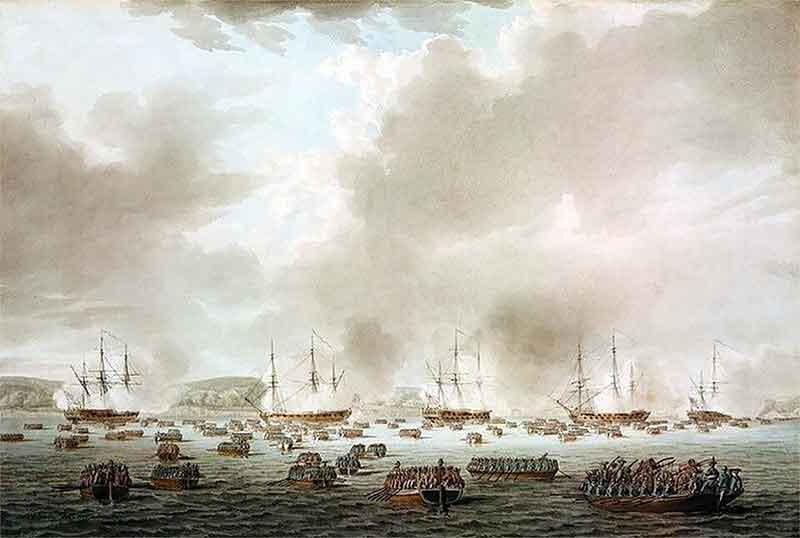
The British Fleet in New York, September 15, 1776
In this dire extremity, in late 1775, Congress called upon John Barry—an Irish-born sailor and merchant—to help them build a navy for these newly free and independent states. Barry accepted “with a determined resolution of distressing the enemy as much as in my power.”
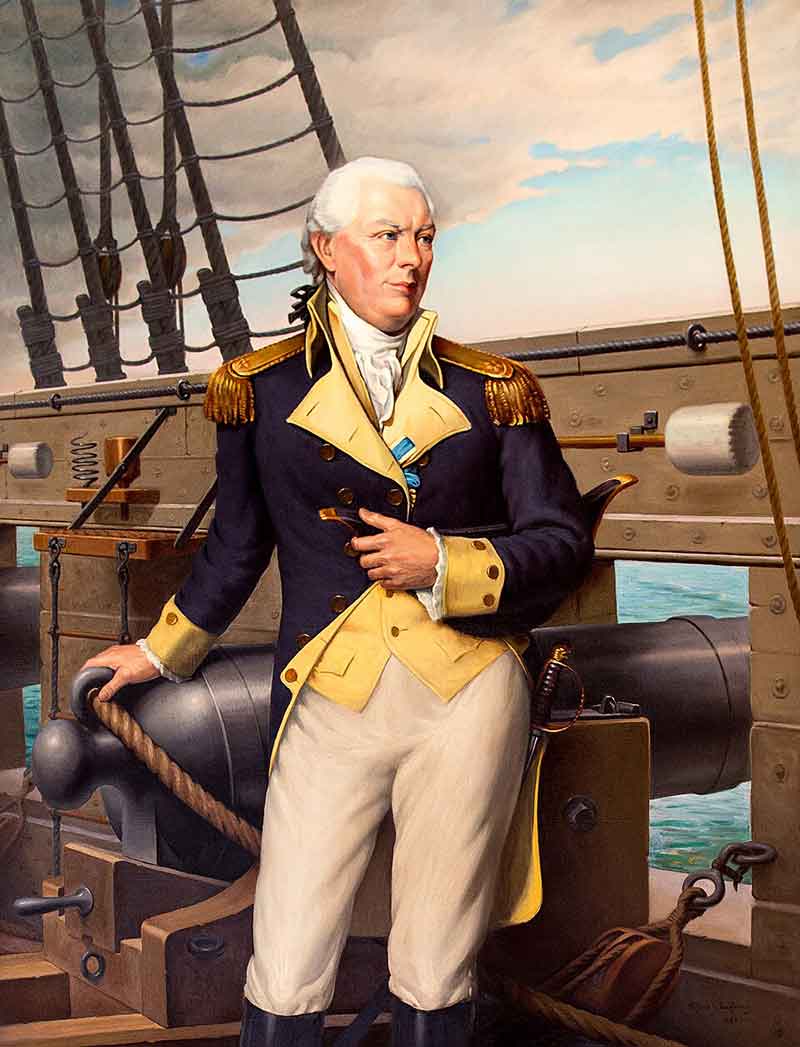
Commodore Barry in his element—aboard a warship
Even before Congress acted, there had been clashes at sea between colonists and the British armed forces, beginning only a few days after the battles at Lexington and Concord. For, in response to the stringent impositions of the British Government on mercantile trade and the impressment of their seamen, men like John Glover of Marblehead and John Hancock of Boston were driven to arm their vessels, and even to engage violently with any ships of the Crown they encountered. Privateering blossomed along America’s shores during this time, tacitly condoned by the provisional governments of the various colonies as the only means available of meaningful resistance and perpetuating trade.
Eventually in late 1775, while yet shrinking from irrevocable separation, Congress heeded John Adams’ deafening demands for the creation of a Continental naval force. Adams served on the Naval Committee that authorized the first purchase and fitting of vessels bought from America’s merchants. The committee then cast about for a man to organize the endeavor, and found him right beneath their noses in the employment of their fellow member, Robert Morris.
John Barry was already a well-established Philadelphia shipmaster by 1775, commanding the ships of many of Philadelphia’s largest firms, including that of Morris. Born to poor tenant farmers in County Wexford, Ireland, he was self-educated and had risen from cabin boy to command of merchant vessels in the West Indies and Atlantic trade, with a stellar reputation as a reliable, skilled, and successful captain—someone who knew ships, crews, and the Delaware waterfront intimately.
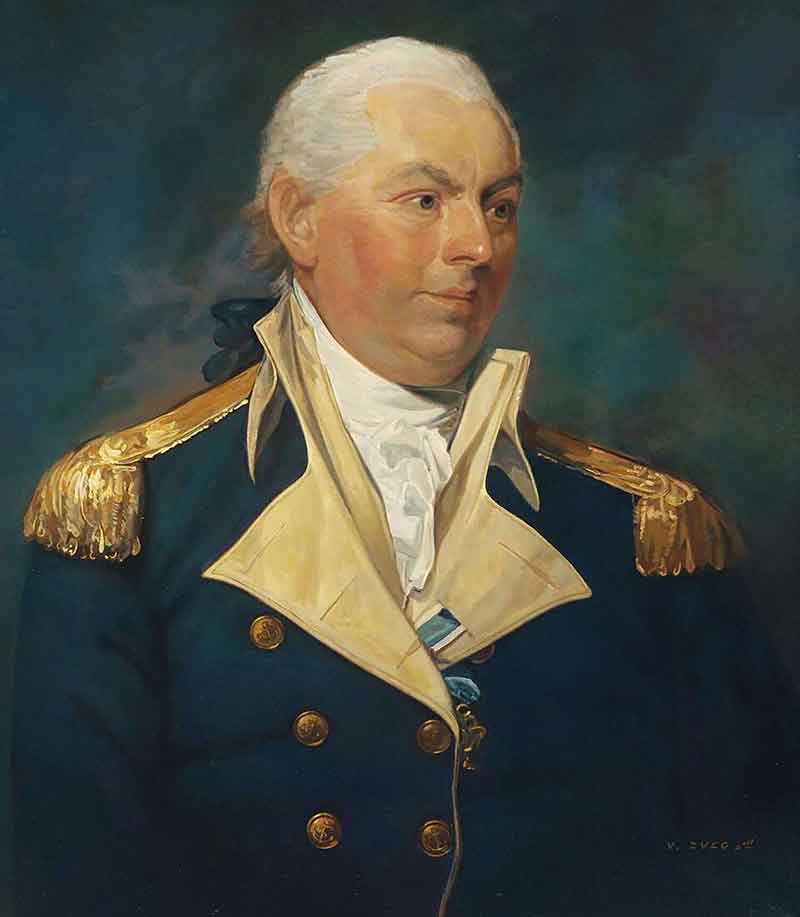
Commodore John Barry (1745-1803)
As Congress began buying merchant hulls to turn into warships, Barry’s command Black Prince was purchased and renamed Alfred, and a yet-unknown Lieutenant John Paul Jones raised the Grand Union flag of the colonies on her—the first time the Continental colors were hoisted on a warship.
It fell to Barry to oversee the tremendous task of converting this haphazard collection of vessels into a fit navy: re-rigging them, arming and outfitting them with the meager funds Congress allowed and in the constant fear of attack or interruption. Working alongside shipwright Joshua Humphreys on structural changes, Barry produced a squadron by the time Independence was declared. This practical role put him in daily contact with both Congress and the enterprising men who would go into legend as commanders of the young American Navy.
Barry himself would become enshrined in history and marble as the Father of the American Navy, a moniker he has been made to share with the inimitable John Paul Jones. And while it is true that Jones is the better remembered of the two and rightfully credited for pioneering daring naval tactics and achieving against-all-odds victories that would make up the legend of that early enterprise, it was Barry who became the Washington of the seas. He established a navy out of nothing, led it with great personal heroism, displayed unequaled diplomatic ability, and proved to have staying power in his office.
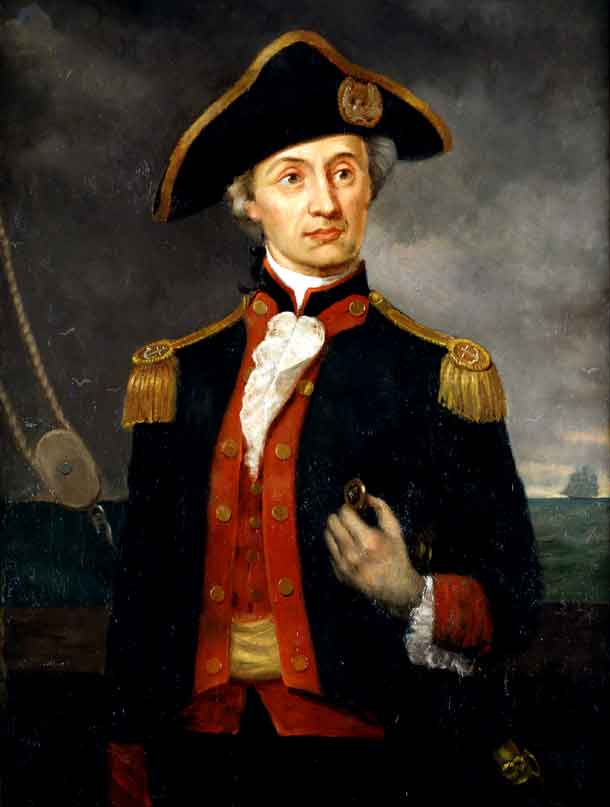
Captain John Paul Jones (1747-1792)
Beyond his bureaucratic duties, Barry himself was assigned to command the converted brig Lexington (14 guns), and his captain’s commission was signed by President Hancock himself, dated March 14, 1776. Right away, on April 7, off the Virginia Capes, Barry entered into his first engagement as a commissioned officer with the British tender Edward in a sharp action lasting about an hour and a half. Barry captured her and brought the prize into Philadelphia—the first capture made by the official American Navy. He continued cruising in Lexington through the summer and early fall of 1776, taking additional prizes, before being assigned to the new frigate Effingham (then under construction).
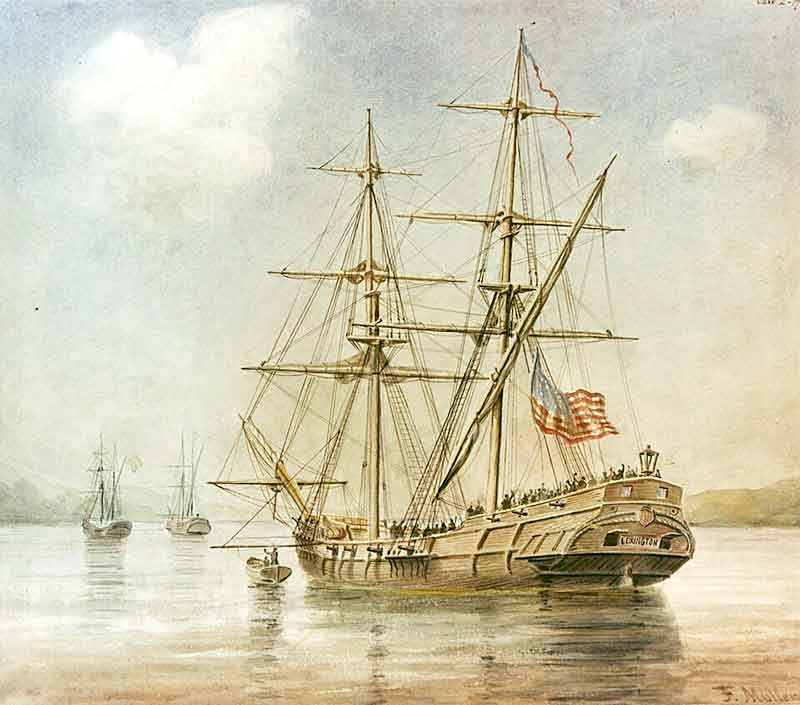
The USS Lexington
While waiting for his new vessel to be fit, Barry learned that General Washington needed men and floating craft for his daring Crossing of the Delaware. It was the dead of winter, the specifics of the surprise attack had been cloaked in secrecy, Barry was without a ship, and besides, the crossing involved a shallow river and not the broad seas which were his expertise. He had no reason to go. But still, Barry raised a company of naval volunteers and marched with them to the banks of the Delaware in support of their brothers. That fateful night, the night of December 25-26, 1776, Barry and his men served alongside Cadwalader’s forces, helping with river crossings and logistics.
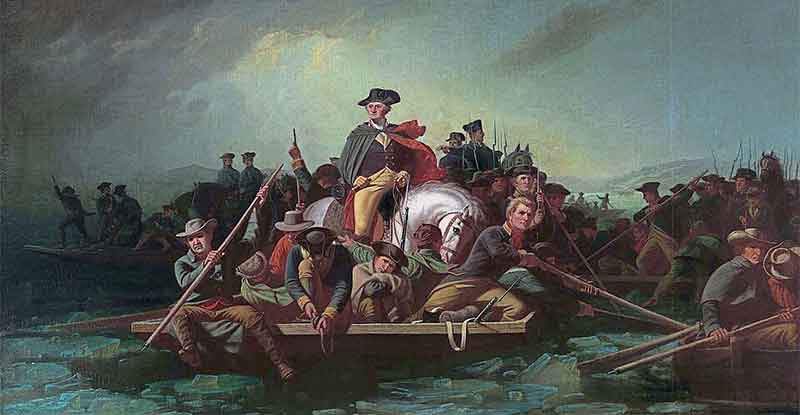
The famous December 1776 crossing of the Delaware River by Washington and his troops
After the crossing, Barry stayed on for the inland campaigns that followed, acting as an aide-de-camp, a position far below his naval rank. Knowing of his dependability, Washington employed him for specific tasks, including carrying his letters and overseeing the safe-conduct of Hessian prisoners and medical personnel after the battles of Trenton and Princeton. Word of Barry’s drive and capabilities had by this time spread all the way to the British high command, and Lord Richard Howe held Barry in such high esteem that he closed out the year 1776 with a flattering proposal for Barry to desert the patriot cause and join the British navy at any rank he chose. Barry only bothered to reply with, “Not the value or command of the whole British fleet can lure me from the cause of my country, which is liberty and freedom.”
A new year brought a new command and new prospects for Barry. He spent the rest of the war in continuous naval service at a time when the Continental Navy struggled simply to keep ships afloat. He commanded Effingham (later scuttled to keep her from the British), Raleigh, and finally the powerful frigate Alliance. With Alliance he carried John Laurens on his ambassadorial mission to France, captured prizes on the return voyage, fought a hard action against HMS Atalanta and Trepassey in 1781 (in which he was seriously wounded by grapeshot but refused to leave the deck), and in March 1783, south of Cape Canaveral, fought what is generally regarded as the last naval engagement of the Revolutionary War. He was known for strict discipline, care of his crews, and for quelling mutinies by force of personality.
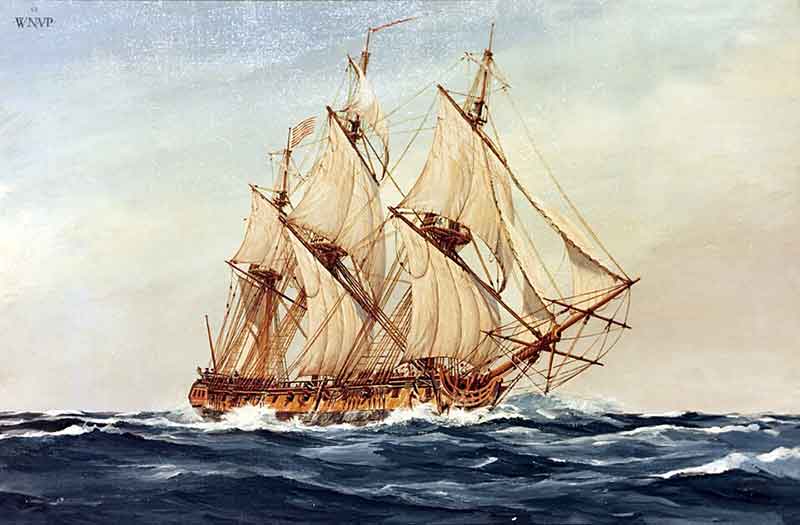
The USS Alliance in full sail
He kept up a warm correspondence with General Washington throughout the war, and got into the endearing habit of sending his Commander in Chief small treats taken from his prizes: cheese, pickled oysters, wine, etc. These Washington accepted graciously, and in turn could be found soothing the Irishman’s annoyance at not winning every battle: “I . . . congratulate you upon the success which crowned your gallantry and address, in the late attack on the Enemy’s Ships—altho circumstances prevented you from reaping the full benefit of your conquest, there is ample consolation in the degree of Glory which you have acquired—You will be pleased to accept of my sincere thanks for the . . .”
After the war this tireless seaman returned to the merchant service in order to serve the United States by transporting Virginia tobacco to Holland to repay U.S. war debts. When Congress approved the creation of a permanent navy under the Naval Act of 1794, Barry wrote to Washington and offered his services; they were most gratefully accepted. President Washington appointed Barry the senior captain of the new service. On February 22, 1797 Washington presented him with Commission Number 1, making him America’s first Commodore.
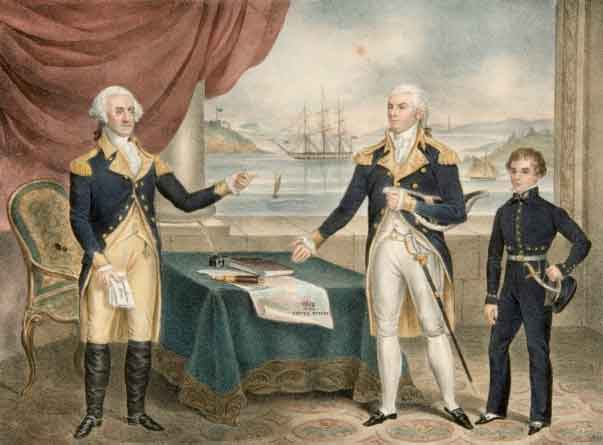
Washington presenting Barry with Commission Number 1, making Barry America’s first Commodore
Barry once again superintended the construction and fitting-out of the first heavy frigates authorized by Congress, including the 44-gun United States, which he commanded during the Quasi-War with France. He helped establish standards of discipline and training, wrote an early signal book, and mentored a generation of officers—among them men who later distinguished themselves in the Barbary Wars and the War of 1812 (sometimes called “Barry’s boys”).
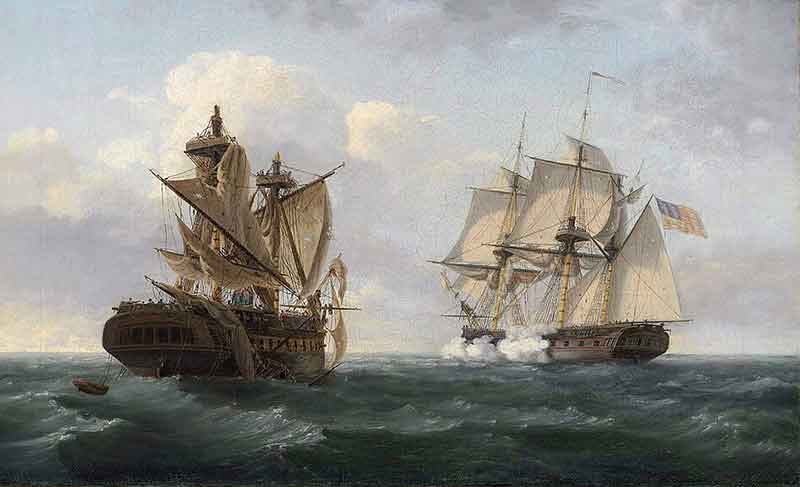
The USS United States (right) against the HMS Macedonian, 1812
Barry was not the most flamboyant of the Continental captains, nor did he win the single most celebrated naval battle of the war. His claim to a founding role rests on longer continuous service, early command of a commissioned Continental ship, seniority in the new permanent navy, practical work building and professionalizing that navy, and the officers he trained. For these contributions, it is his statue which stands opposite Washington’s in the shady mall behind Independence Hall. For liberty is only worth what her guardians are willing to risk in defending her. Benjamin Rush’s epitaph for him would have us remember “his habits of war did not lessen his virtues as a man nor his piety as a Christian.”
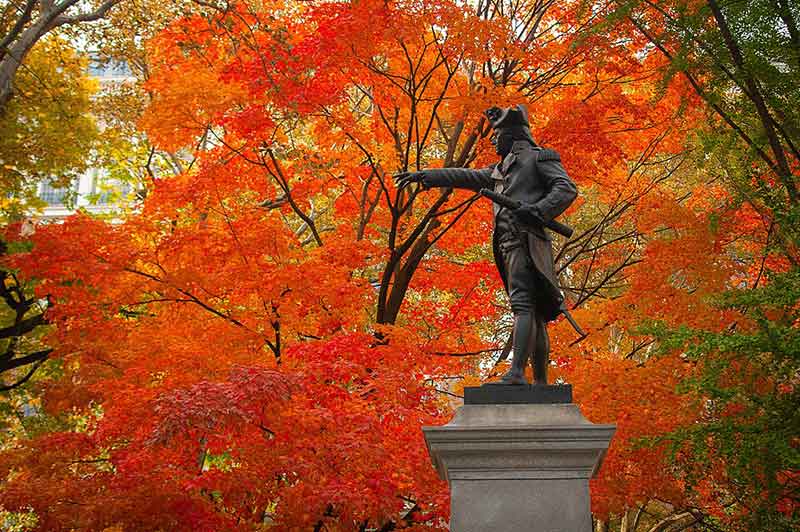
Memorial statue to John Barry behind Independence Hall, Philadelphia, PA
Image Credits: 1 New York, 1776 (wikipedia.org) 2 Barry on ship (wikipedia.org) 3 Commodore John Barry (wikipedia.org) 4 Captain John Paul Jones (wikipedia.org) 5 USS Lexington (wikipedia.org) 6 Delaware Crossing (wikipedia.org) 7 USS Alliance (wikipedia.org) 8 Commission (wikipedia.org) 9 USS United States (wikipedia.org) 10 Barry statue (wikipedia.org)