

Profiles of 1776 | The Wolcott Family
 ew anecdotes from America’s pivotal year of 1776 are as delightful as the one involving Founding Father, soldier, and Connecticut representative Oliver Wolcott and his remarkable little family of “rebels.” When the year began, Wolcott was juggling two careers: as his state’s principal delegate to the Continental Congress, and as Commander of the Connecticut militia. Congress had also appointed him Commissioner of Indian Affairs, his previous service in the French and Indian War having made him well suited for the role.
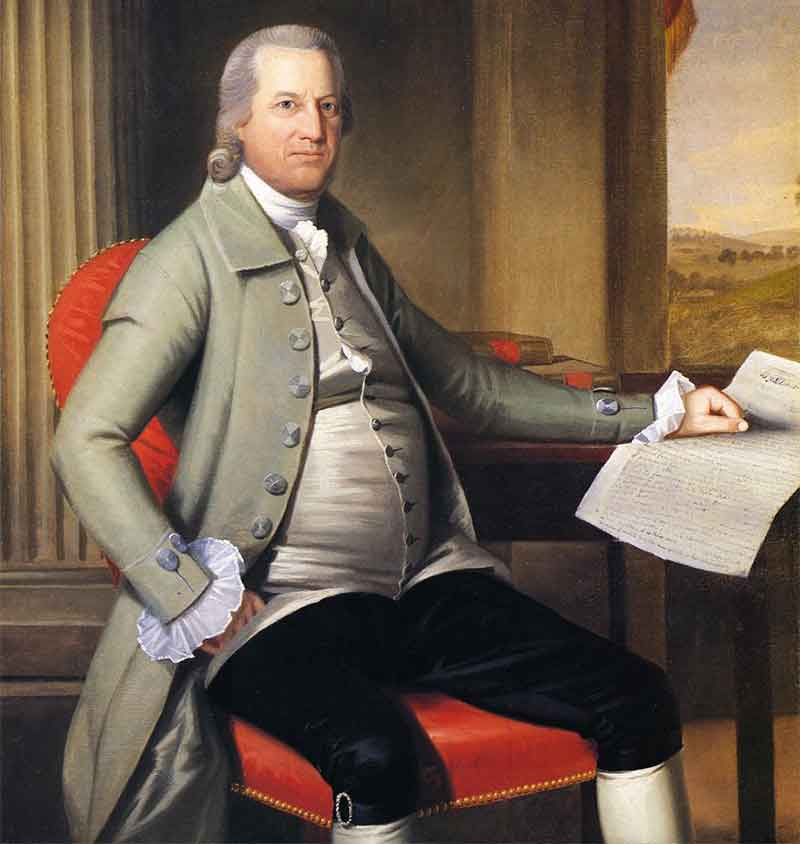
Oliver Wolcott, Sr. (1726-1797)
He proved Congress’s trust in his merits by hammering out a treaty with the Northern Indian nations, binding them to remain neutral during the upcoming conflict. He did this three separate times, all successfully. By these treaties, many settler families were spared the atrocities that had been inflicted upon them in previous wars.
All these achievements aside, Wolcott’s greatest disappointment of 1776 was his absence from Congress during the momentous vote for Independence. Gravely ill at the time and far away with his militia, he missed the proceedings in Philadelphia on July 4. It would be months before he could affix his name to the document he had helped to craft. But it was this sad absence that allowed him to witness a scene most of his contemporaries missed.
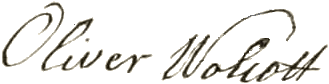
Signature of Oliver Wolcott, Sr.
When the irreparable break from Great Britain was decided upon, General George Washington’s irregular Continental Army was in New York City, preparing to repulse an imminent and massive invasion by both the British army and navy. It was therefore of the utmost importance for the President of Congress, Mr. John Hancock, to quickly dispatch a fresh copy of the Declaration of Independence to the Commander in Chief. And so it was that on July 9, in New York City, the ordinary militiamen from every state—who had fought for over a year under a variety of banners and for a cause still nebulous in its desired outcome—first learned that they now had a country of their own. The reaction was tremendous and not entirely orderly.
Oliver Wolcott was in New York for this occasion, and there he witnessed not only the joy of the soldiers and the effusion of passion many citizens displayed, but also one of the most bizarre demonstrations of patriotic fervor ever expressed in colonial America. For General Washington had hardly finished reading the document when a motley group of soldiers, citizens, and ne’er-do-wells stormed Bowling Green in the Wall Street area. In their zeal, they toppled the stately and gigantic equestrian statue of His Majesty—chief enemy number one—King George III. Having done this, the mob proceeded to smash it to bits on the green before taking its head and parading it on a pike through the city streets. It was rumored to have later been sent to London as a taunt.
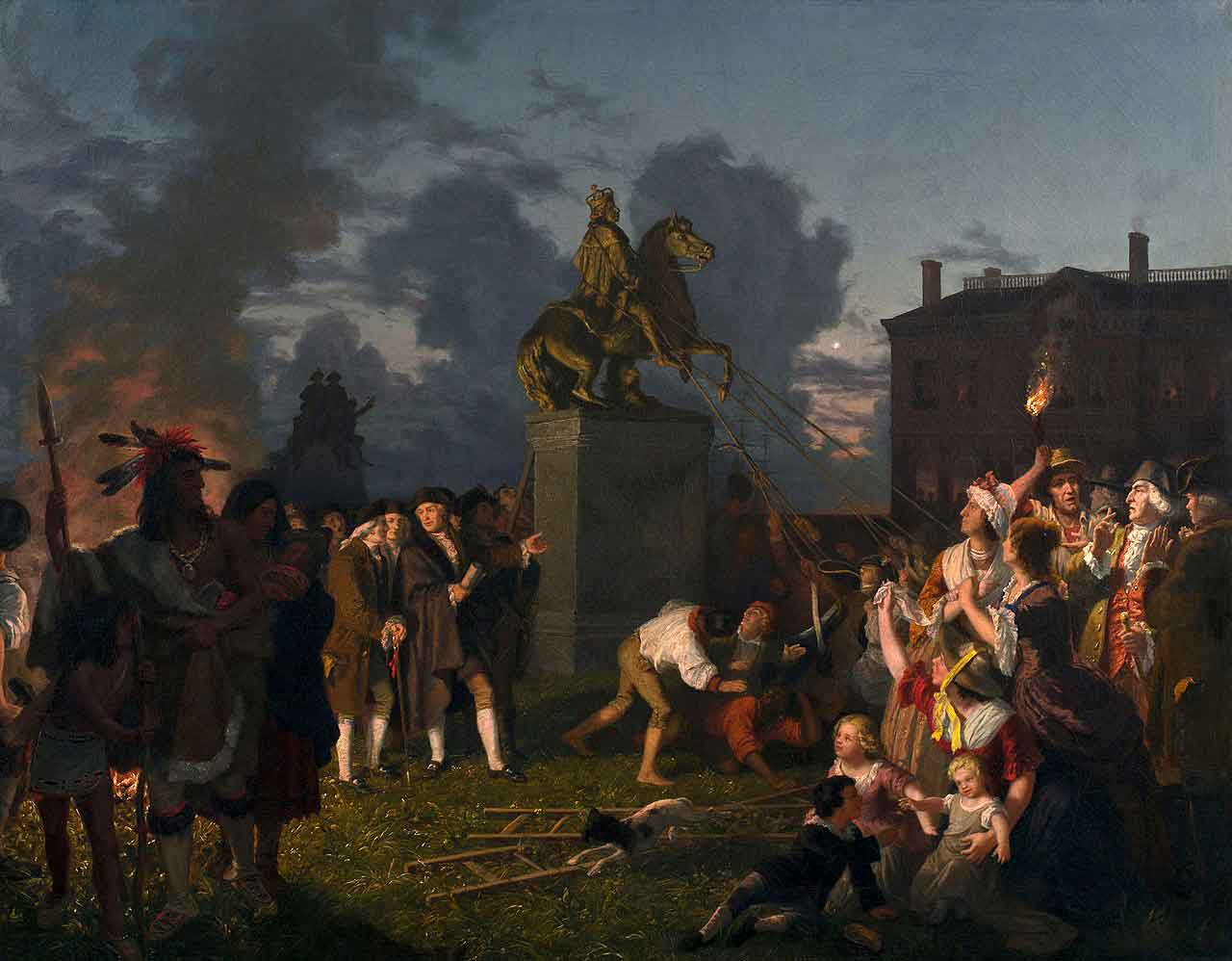
King George III’s statue on Bowling Green in New York being toppled by the excited mob
The mob then moved on to other celebratory actions, many equally destructive but of less political impact. Yet Wolcott remained on the green amidst the wreckage. The statue had weighed about four thousand pounds and was made of pure lead with a fine coating of gold leaf. As a militiaman and an old soldier accustomed to providing his own kit, Wolcott looked at that heap of rubble and had an epiphany. Bullets were made of lead, and bullets had been terribly hard to come by for the Americans. His soldiers often had to meet the enemy with no more than five or ten bullets each, if they were lucky, and Congress had proven unable to supply more.
Wolcott collected the salvageable pieces and arranged for a ship to take the heavy material by sea to the port of Norwalk, Connecticut. It was then loaded onto oxcarts and hauled sixty miles to his house in Litchfield. There, in the family orchard behind his house, he enlisted the help of his wife, children, and the local ladies to smelt and mold the rubble into ammunition.
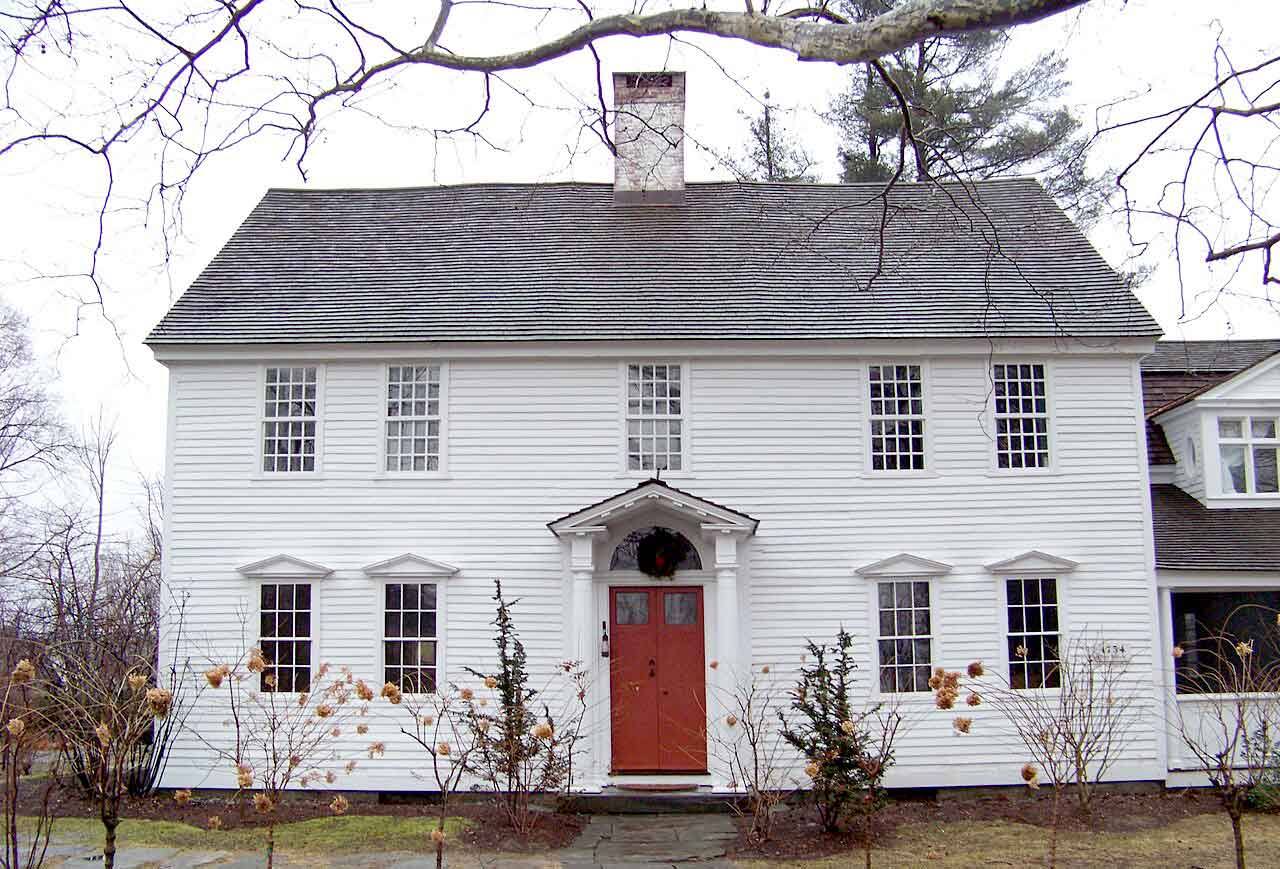
The Oliver Wolcott House, Litchfield, CT, front
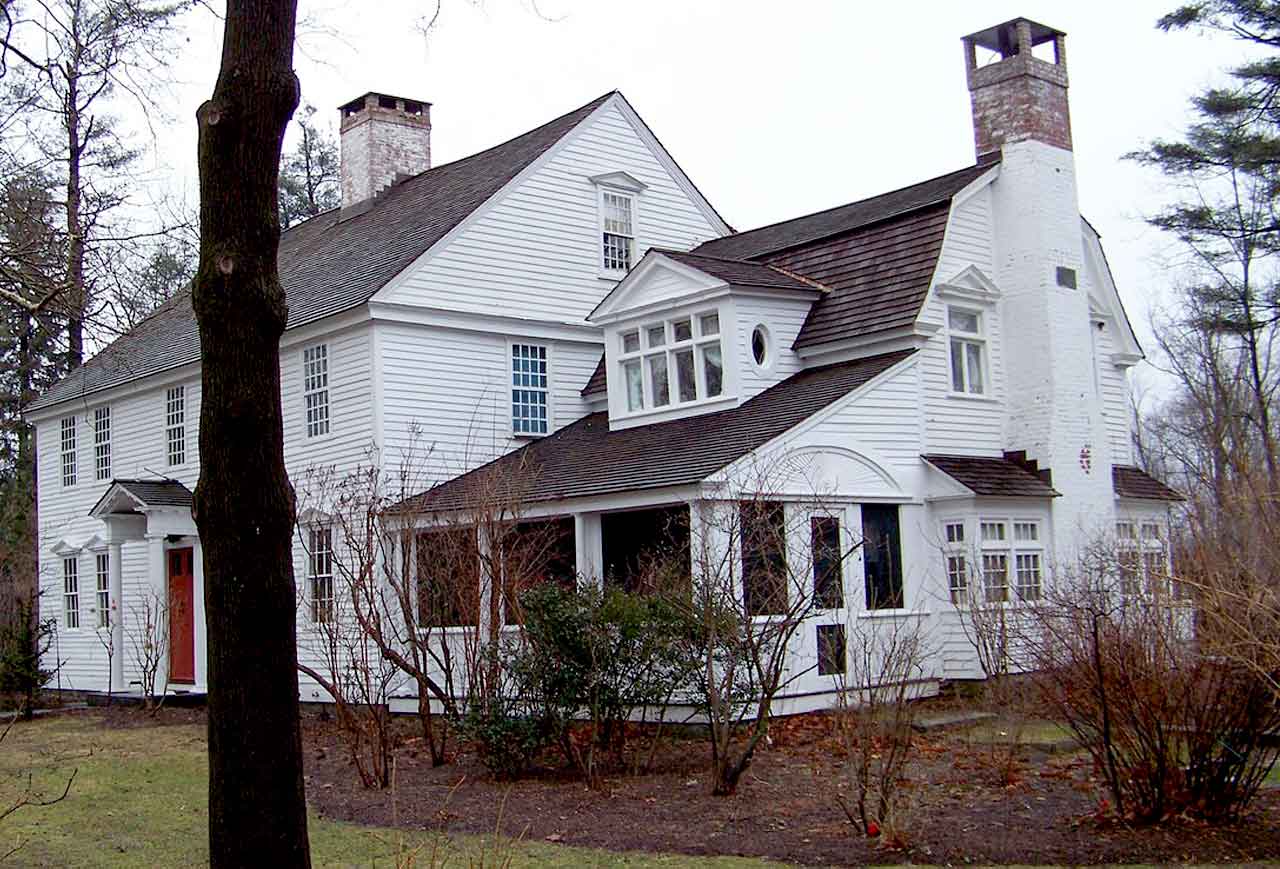
The Oliver Wolcott House, Litchfield, CT, front/side
Wolcott’s son, Frederick Wolcott, would later attest that his father—tall, muscular, and still in the prime of life—took an axe to the larger portions himself, dividing them into manageable pieces for Mrs. Wolcott’s great cauldrons, which were themselves sacrificed for the cause. Frederick also kept careful accounts of the production rate of their merry little band of melters, reporting a grand total of 42,088 bullets formed from the statue. It was recorded that Laura Wolcott, age fifteen, made 8,378; Mary Ann Wolcott, age eleven, made 10,790; and Frederick himself, at age nine, a respectable 936.
Proud papa Wolcott took these bullets with him into the Battle of Saratoga, furnishing his men with them and thus helping to defeat General John Burgoyne’s army with “hot blasts of His Melted Majesty.”
Wolcott would eventually sign the Declaration of Independence in October 1776 and later added his name to the Articles of Confederation in 1777. He survived the war, as did his wife and children. This most industrious and utilitarian Founding Father then took a well-deserved retirement at his home in Litchfield, although he remained active as Lieutenant Governor and took an enthusiastic part in local deliberations on the formation of our Constitution.
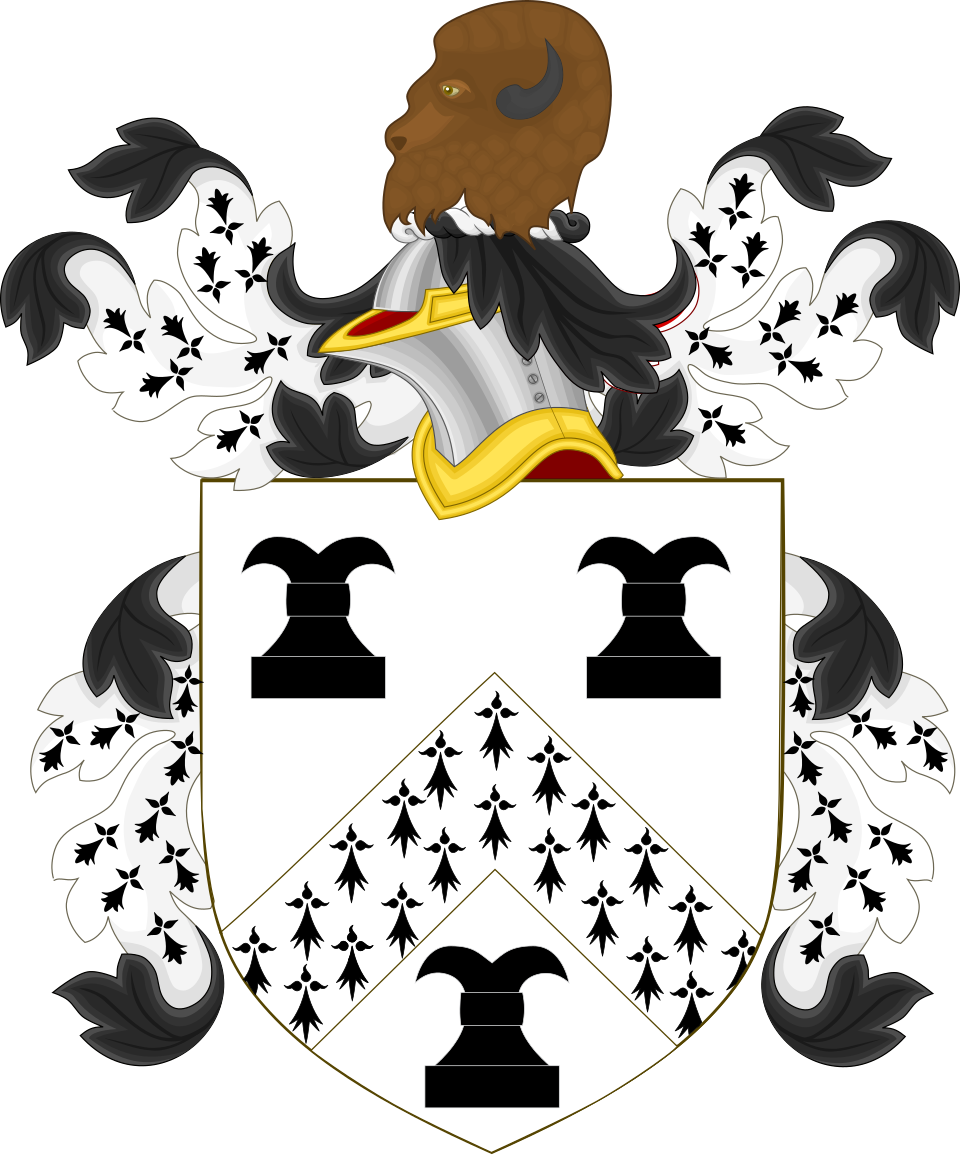
Coat of arms of Oliver Wolcott
He was pulled from his ease in 1796 upon being elected Governor. Himself the fifteenth child of a previous governor of Connecticut, he was proud to step into the office his father had held forty-five years earlier—but now within a radically different and sovereign nation that he had helped to create. Of Wolcott’s character, which produced his own great contributions and those of his distinguished family, his biographer Sanderson wrote this glowing summation:
“As a patriot and statesman, a Christian and a man, Governor Wolcott presented a bright example; for inflexibility, virtue, piety and integrity, were his prominent characteristics. His integrity was inflexible, his morals were strictly pure, and his faith that of a humble Christian, untainted by bigotry or intolerance. Mr. Wolcott was personally acquainted with, and esteemed by, most of the great actors of the American Revolution, and his name is recorded in connexion with many of its most important events. It is the glory of our country, that the fabric of American greatness was reared by the united toils and exertions of patriots in every state, supported by a virtuous and intelligent people. It is peculiar to our revolution, and distinguishes it from every other, that it was recommended, commenced, conducted, and terminated under the auspices of men, who, with few exceptions, enjoyed the public confidence during every vicissitude of fortune. It is therefore sufficient for any individual to say of him, that he was distinguished for his virtues, his talents, and his services.”
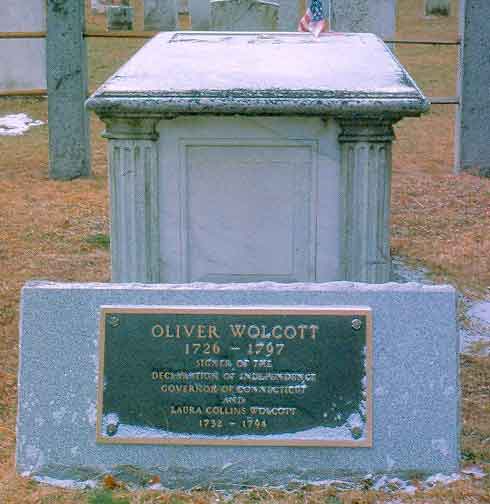
Grave of Oliver Wolcott, Sr. and his wife, Laura
Image Credits: 1 Oliver Wolcott, Sr. (wikipedia.org) 2 Signature of Oliver Wolcott (wikipedia.org) 3 Toppling King George III (wikipedia.org) 4 Wolcott House, front (wikipedia.org) 5 Wolcott House, front/side (wikipedia.org) 6 Wolcott Coat of Arms (wikipedia.org) 7 Oliver & Laura Wolcott Grave (wikipedia.org)